
An extreme environment requiring absolute reliability
The nuclear power generation industry—think of names such as EDF, Framatome, Westinghouse, and Electrabel—is one of the most strictly controlled sectors in terms of quality and safety. Every component installed in a power plant, reactor, heat exchanger, or primary circuit is subject to stringent standards. The slightest failure can have major consequences for the safety, maintenance, or durability of the facilities.
The mechanical parts used in this context are generally made of special or even very hard materials, such as Inconel, Zircaloy (zirconium), tungsten, refractory stainless steel, or vanadium-chromium-molybdenum or cobalt-chromium alloys. They must be resistant to corrosion, heat, radiation, and repeated mechanical stress. But beyond the properties of the materials, it is the precision of the machining that determines their proper functioning: micron tolerances, perfect alignment, controlled roughness, and absence of microcracks.
The manufacture of such components is not possible using conventional milling or turning techniques alone. Non-traditional processes are required that are capable of respecting the geometry, minimizing residual stresses, and ensuring perfect traceability.
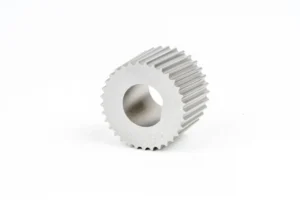
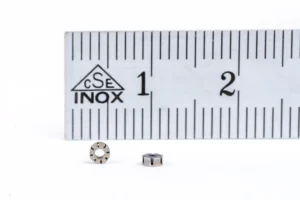
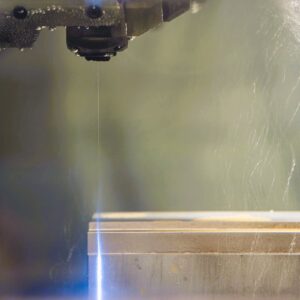
Electrical discharge machining and micro-machining: the solution for critical nuclear components
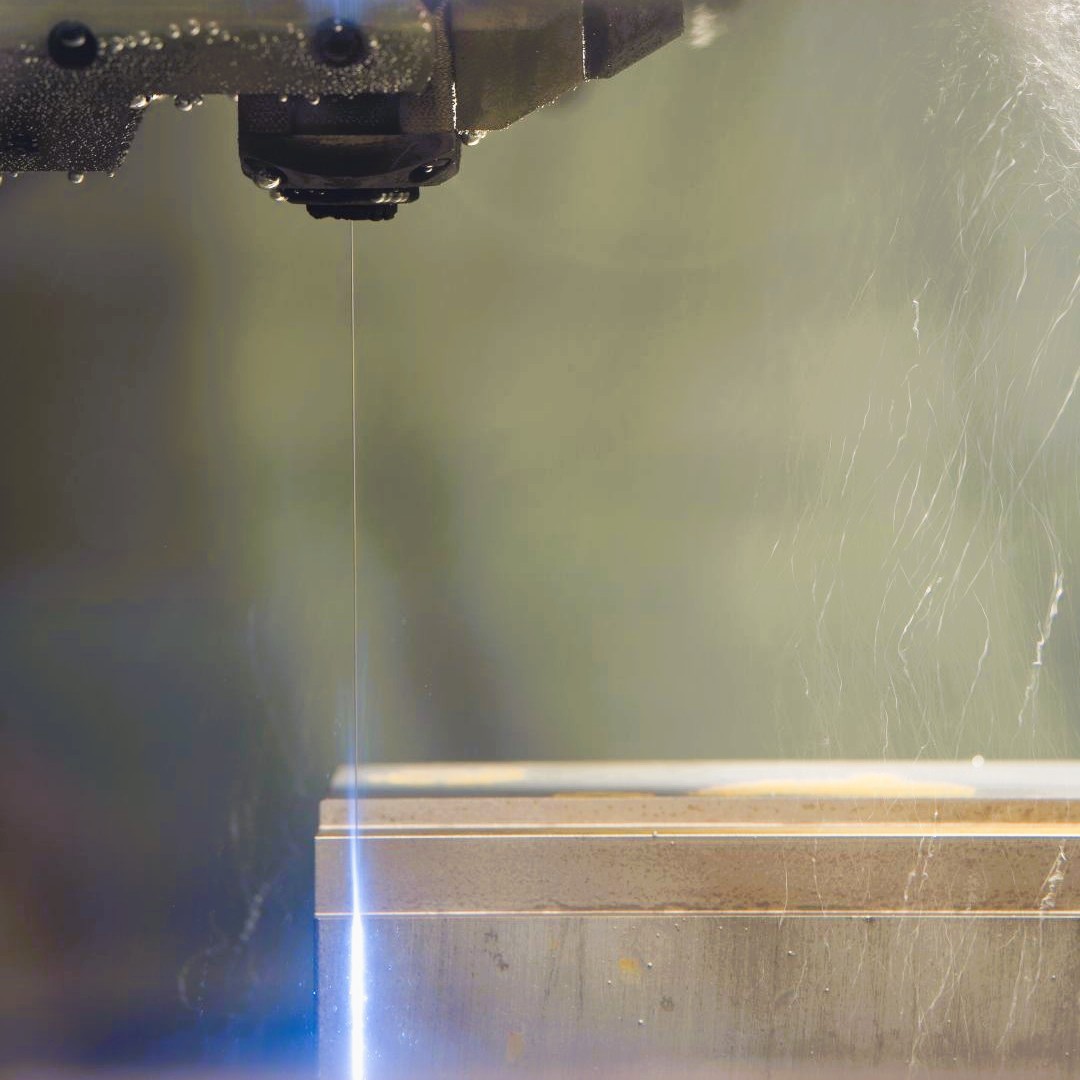
Electrical discharge machining (EDM) offers an ideal solution for machining complex parts made of special or refractory alloys. This process involves no mechanical contact between the tool and the part, which preserves the integrity of the structure and prevents deformation. Using die-sinking EDM or wire EDM, it is possible to produce clean internal shapes, pockets, grooves, and deep holes with extremely fine tolerances.
High-precision machining produces parts with exceptional surface finishes (Ra < 0.2µm), which is essential in contact areas or mechanical interfaces, such as flat and cylindrical grinding processes, or even better. For assembly areas, coaxiality, parallelism, and flatness are ensured by checks in a stabilized environment, using 3D sensors—on a three-dimensional measuring bench—or optical sensors—optical coordinate control (high-precision dimensional image measurement).
Micro-drilling is also a fundamental lever in the regulation or cooling circuits of nuclear components. It allows the production of ventilation, expansion, or fluid circulation holes with diameters of less than 0.2 mm, similar to laser machining, but without burrs and with excellent parallelism at high depths.
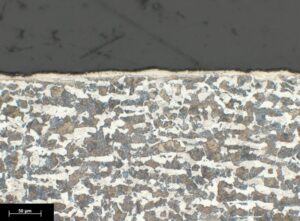
Mecasoft: proven expertise in the machining of complex nuclear components
Mecasoft has long been a trusted partner for parts suppliers in the nuclear energy sector. Its experience in machining complex technical parts, combined with a rigorous quality culture and advanced dimensional control methods, enables it to meet the most stringent requirements of the sector.
The company specializes in the production of single parts or small series, always based on technical drawings provided by the customer. Each production run is accompanied by complete documentation: material certificate, inspection report, self-inspection sheet, process traceability. These series are sometimes reproduced over many years, requiring exemplary traceability.
Thanks to its modern machinery, Mecasoft is able to consistently machine parts with tolerances of <5 µm, even in difficult materials such as Inconel or Hastelloy. Its expertise in electroerosion, micro-drilling, and heat and surface treatments makes it a preferred subcontractor in this highly regulated field.