
The vital importance of metrology in the manufacture of precision parts
In the world of micromechanics and high-precision machining, producing a compliant part does not simply mean “being close to right.” It means scrupulously adhering to the drawing in terms of dimensions, shapes, surface finishes, symmetry, flatness, and coaxiality. When tolerances are less than 5 microns—or even one micron—dimensional control is no longer a formality, but a critical link in the production chain.
Whether for parts intended for medical, aeronautical, electronic, automotive, or nuclear applications, quality assurance relies on advanced metrology. It not only guarantees the conformity of a part, but also detects process deviations before non-conformities appear in series production. Effective industrial metrology is therefore a tool for validation, production control, and quality traceability.
This need is all the more critical when parts are produced in small batches or individually. In this case, it is not possible to rely on mass production statistics: each part is unique, and every measurement counts.
Modern measurement technologies for micromechanical precision
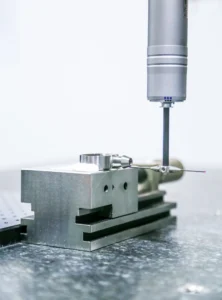
Modern dimensional control processes—known as CMM machines—have evolved considerably to adapt to the growing demands of precision micromechanics. Gone are the days of simple analog comparators and profile projectors: today, measurements are taken on multi-axis dimensional measuring benches, controlled by software and incorporating very high-resolution optical or tactile sensors.
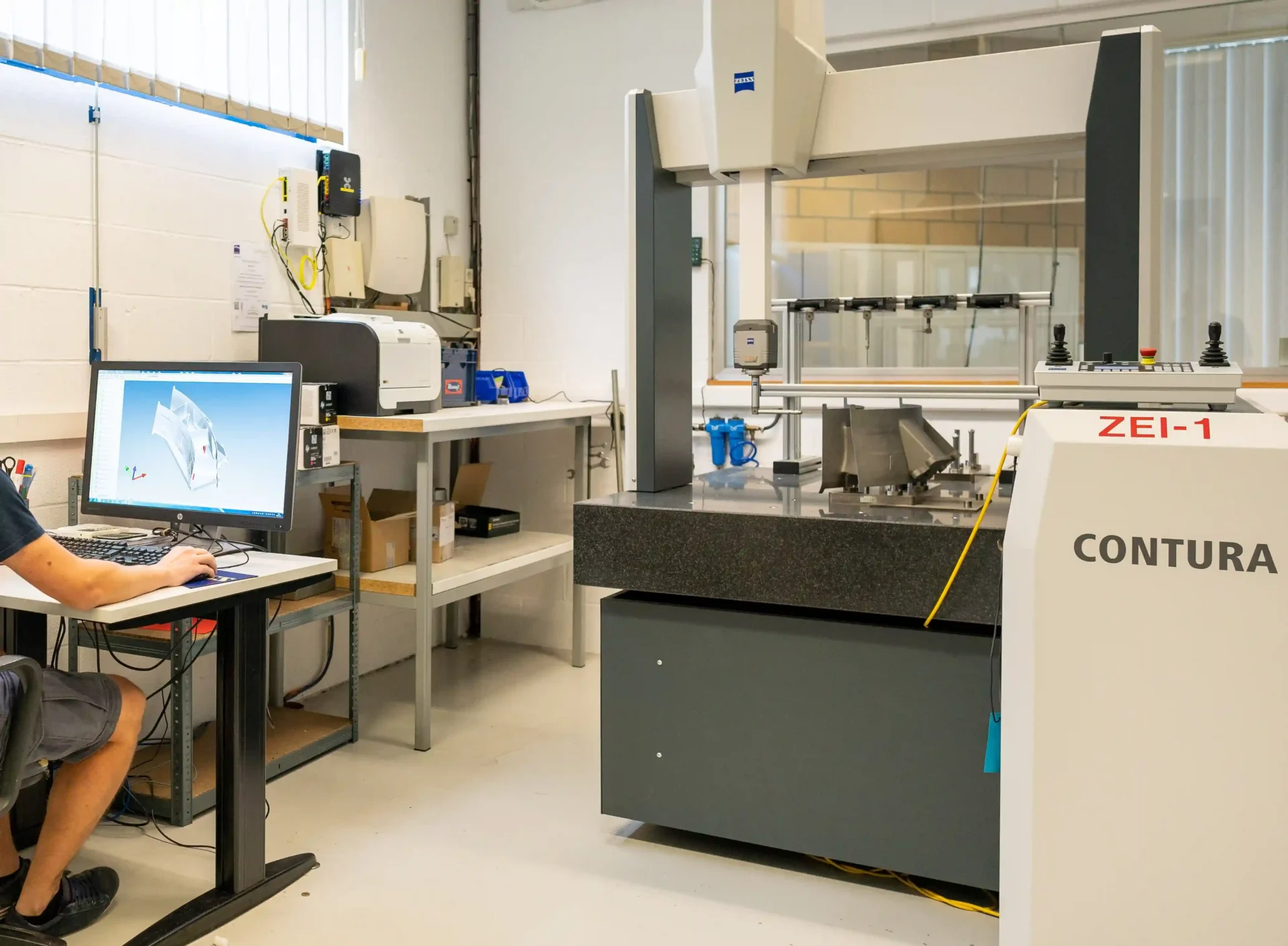
3D probes, capable of measuring complex shapes in space, offer exceptional repeatability and enable the generation of comprehensive measurement reports including dimensions, geometric shapes, position tolerances, and statistical deviations. For smaller parts or those with very fine geometries, high-definition optical measurement allows for rapid, non-contact inspection, avoiding deformation or scratches. Using structured light, multi-angle imaging, or interferometry, even the slightest deviations in flatness or roughness can be visualized in a matter of seconds.
One of the key features of these technologies is their ability to measure in a controlled environment. To achieve micron-level accuracy, the temperature, humidity, and vibration stability of the measured part must be perfectly controlled. This is why this equipment is installed in temperature-controlled (air-conditioned) metrology rooms, where each measurement can be reproduced identically.
Finally, measurement traceability is ensured by exportable digital reports that can be used directly in an ISO 9001, ISO 13485, ISO 19443, or EN 9100 quality process. Each part can thus be delivered with a complete inspection report, guaranteeing the customer absolute confidence in the quality of the component.
Mecasoft: metrology at the heart of precision machining
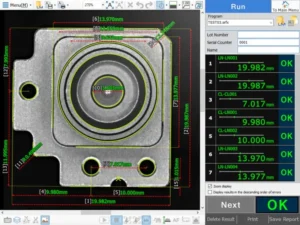
At Mecasoft, a culture of rigorous dimensional control is integrated into every stage of the manufacturing process. Even before machining, teams assess the critical tolerances to be controlled. During production, self-checks are performed at each workstation. And at the end, each part undergoes a final inspection in a dedicated climate-controlled room equipped with the latest measurement technologies—optical, dimensional, or three-dimensional with probes.
The measuring machines used allow for complete, non-contact 3D inspection with micron precision. Comparison software allows actual parts to be aligned with their digital model, immediately identifying any deviations. Inspection reports are systematically attached to deliveries of critical parts, whether they are intended for the automotive, aerospace, medical, nuclear, or defence industries.
Mecasoft’s expertise in precision micromechanics, combined with its advanced metrology equipment, guarantees not only the conformity of parts, but also total control of the manufacturing process. Customers can therefore rely on measurable, traceable, and repeatable quality—a prerequisite for integrating parts into critical systems.